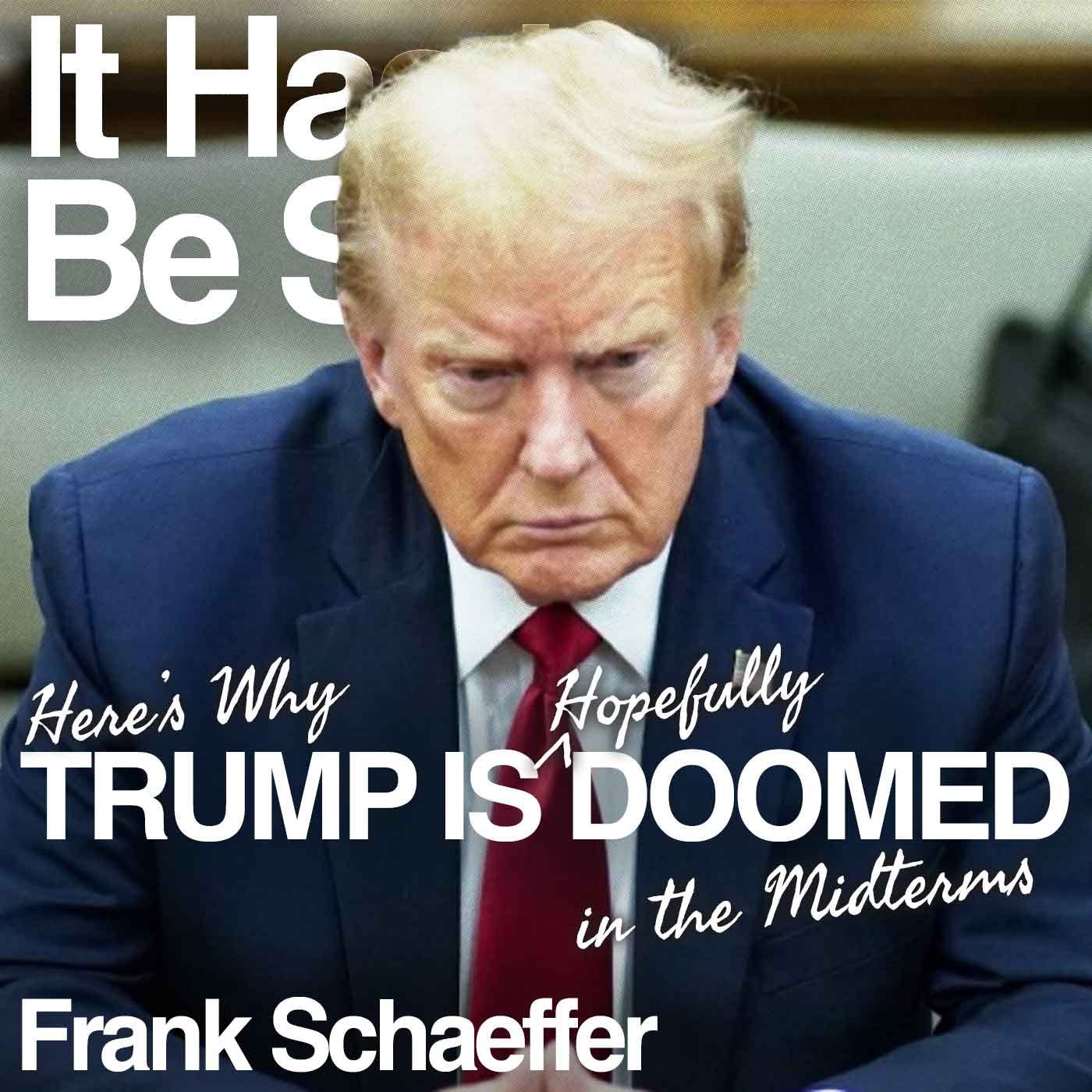
There’s a sentence I read this morning attributed to Donald Trump in Peggy Noonan’s latest Wall Street Journal column that may turn out to be the most revealing thing said about Trump so far.
Before the war with Iran began, according to Maggie Haberman and Jonathan Swan, Tucker Carlson warned Trump against getting into it. Trump reassured him, “I know you’re worried about it, but it’s going to be okay.”
Carlson asked, “How do you know?”
Trump’s answer was, “Because it always is.”
There it is. The Trump presidency in four words. The gambler’s conviction when he has survived bankruptcies, scandals, impeachments, divorces, accusations, criminal trials, that all his trouble is just history.
And it’s full of people who thought exactly the same thing right up to the moment they self-destructed and it wasn’t okay.
Something I’ve been talking about on my podcast, In Conversation with Frank Schaeffer, and my Substack commentary page, It Has to Be Said, which I’m doing right here now with you, including this commentary, is that the 2026 midterm elections approaching are a time when Republicans are wondering whether maybe it isn’t always going to be okay.
Katy Balls, Washington editor of the Sunday Times, reports from inside Republican Washington that the fear is no longer merely that the party might lose the House or even the Senate. Republicans she spoke to recently are worrying about races in places they had assumed were safe for decades: Kansas, Oklahoma, Florida, Iowa, even Nebraska.
However those races turn out, money right now is being spent on those states that used to just go to battlegrounds. And now it’s spent defending safe Republican territory. Trump is even campaigning in places like Alabama and Oklahoma.
One Republican strategist told Balls, “We now need to spend money to hold safe ground.”
The midterm elections are still a month away. And everybody could be wrong about the results.
That said, and the fact that campaigns change, nevertheless leaves us with a very definite fact. Something measurable has already changed.
A Reuters/Ipsos poll released September 21 put Trump’s approval rating at a whopping low 32 percent, the lowest regarded any president within living memory, while only 17 percent approved of his handling of the cost of living, the issue Americans in that poll identified as the most important in their midterm vote.
Only 17 percent of Americans. That includes everybody, not just Democrats. Republicans too.
Registered voters preferred Democrats over Republicans for Congress by 43 to 35 percent. And again, that’s everybody, Republicans included.
What interests me even more than those polls is what Republican politicians themselves are doing because politicians possess one genuinely impressive evolutionary adaptation. They can smell approaching electoral disaster.
This does not mean that these Republicans have suddenly experienced mass conversion. Far from it. They aren’t becoming Democrats and most aren’t even repudiating Trump.
In other words, these are still gutless, boneless wonders and characters you might describe as cowards.
For almost a decade, the central political law of the Republican Party was that disagreement with Trump is fatal. He could humiliate you, threaten you, let loose fans who would send you death threats. Yes, he did that. Primary you.
Now some of those same politicians seem to be rediscovering an even older political law than fear.
And it’s this: Eventually, the voters will send you the bill.
Which brings me back to staunch conservative Republican Peggy Noonan, because she’s actually writing about something much bigger than mere midterms. She’s calling out Trump for catering to artificial intelligence and the billionaires who have created it.
At the United Nations, Trump rejected international attempts, at the same time as he said we were winning in Iran, or he would annihilate them, to impose global controls over what he likes to call superintelligence, dismissing such efforts in the familiar language of globalist interference as fake news.
In other words, it was fake news that we might fear out-of-control AI or the billionaires creating it without a thought for our future well-being.
Noonan’s point was not that AI is always going to be catastrophic or that there’s the end of the human race on the way. Neither she nor I nor you know that.
The connection here is Trump’s temperament, the assumption that warnings are for fools, experts are usually idiots, restraints are imposed by cowards, and everything will work out because everything has always worked out for him, as it still is now, as he’s made close to two billion dollars in the first two years of his second term.
A catastrophic proportion of corruption that has never been seen in American history before and would have shamed a Roman emperor.
Now this gets personal for me because I’m old enough to remember a world before all this.
I grew up before personal computers, smartphones, the internet, social media, and those little glowing rectangles we all carry, on which I’m now recording my voice for you on my It Has to Be Said commentary page that will be on Substack in a minute, and then on YouTube.
Artificial intelligence belonged in science fiction, I once thought. And I’m not against technology.
Listen, as a dyslexic writer, yes, there is such a thing, that’s me. I bless spellcheck almost every day. I edit books using machines my parents could scarcely have imagined, and my old missionary grandparents would have thought were works of Satan.
I talk to grandchildren instantly who are a thousand miles away in college right now. Thank you, Jesus, is the reaction I have every time a word is corrected on my laptop.
I feel less stupid because of it. Thank you, Jesus.
But now we’re building something incomprehensibly more powerful than anything I ever used while being told by Trump that the race cannot possibly be slowed because, well, China.
So let’s hurry up and complete whatever AI does to us, and his buddies will bail him out. Maybe show up again in the Oval Office with a chainsaw and cut the budget of anyone who dares question the way they’re making trillions. Whatever. We’re used to this now.
And you don’t have to accept the most apocalyptic version of AI warnings to understand a basic point.
Human beings are building systems of enormous power whose capabilities are developing faster than our political, moral, legal institutions are learning how to deal with them.
That’s not disputable. That’s a fact.
And it’s not fake news. It’s fact news.
And as for me, I’m listening to another man who stood up to Trump. Pope Leo. Someone I have immense respect for.
And this is where Trump’s political strength begins to look very much like a political weakness.
Trump knows Leo is right. Trump knows everyone else who is fearing AI is right. But Trump won’t admit it because, politically speaking, he only speaks in terms of certainty.
And one of his certainties is, I never back down. I never admit I could be wrong.
And that’s worked brilliantly for him because millions of Americans had good reason to distrust institutions whose experts had been wrong, arrogant, or both.
A liberal media that did ignore them and did look down on them. A university elite that did ignore them and did look down on them and did try to indoctrinate their children in left-wing humanities programs with some very stupid ideas that you have to be a PhD to believe.
All that’s true.
But you see, skepticism about experts is not the same thing as contempt for expertise. Facts are not all fake news.
And this is where Pope Leo sounds sane in questioning AI and Trump sounds like, I’m sorry, a fool.
And that’s because humility is not weakness.
In fact, the older I get, and perhaps this is part of what my strange return to faith I’ve been talking about and that I’m writing a new book about has been trying to teach me, the more suspicious I become of certainty, including my own certainty.
The wiser I have become. I’m not claiming wisdom, but my uncertainty is where whatever wisdom I have lies.
The precious phrase that I use a lot these days and that I didn’t use as a young man: “But I could be wrong.”
And because of that, I also honor expertise.
I’ll give you an example. You can just see the scars on my head left from some major surgery I had a couple years ago. My dermatologist teaches at Harvard. God forbid, he’s an expert.
And he caught the melanoma that would have killed me.
And the surgeon at Mass Eye and Ear also teaches at Harvard. God forbid, Harvard. And he did the surgery. And I’m fine now.
Because experts are experts for a reason.
That is why this Republican unease interests me, because it goes far beyond the horse race.
It’s linked to vaccine denial resulting in mass measles epidemics. It’s linked through Trump to Kennedy and his outright stupid anti-vax lies. It’s linked to the generals that Trump’s fool in the Department of Defense has fired, who warned him that the Iran war would not go well, who told him and Trump the truth, and they’re gone now.
For a decade, Republican politicians were trained to believe that closeness to Trump meant political survival, including winking at his populist lies, his self-evident untruths.
But now some of them are discovering that Trump’s problem can become their problem and will in the next election because, and I put this in capitals to you if I may say so, TRUTH MATTERS.
No melanoma here now. I listened to an expert.
A war lost in Iran because Trump didn’t.
Simple.
The Iran war is no longer an abstraction because diesel prices hit farmers and truckers, and my wife and I are wondering how to heat our home this winter without going broke.
I’m glad I have four cords of wood that I’ve been stacking all summer and a wood stove in my kitchen, and the rest of the house will just have to be cold. I hope my pipes don’t freeze.
And that’s why approval among Republicans has fallen from 82 percent to 73 percent in a week, in just one poll, while 51 percent of Republicans now disapprove of his handling of the cost of living, compared with only 44 percent of Republicans who voted for him who now approve.
Maybe they have oil-fired heaters too. Maybe they drive to work. Maybe they buy groceries. Who knows? Even Republicans may eat occasionally and buy groceries.
And maybe that’s why I think Trump is probably doomed in these midterms.
Not because I’ve suddenly become a pollster, but oil heat are things people encounter while trying to live in a wintry climate, and filling the tank and buying groceries and paying bills hits even people in Florida.
And heating homes and wondering why a war they were told would be short is still going on, and that they’ve been told dozens of times by Trump, “We won,” and then somehow we haven’t won, is still happening.
Still, I keep putting that word “probably” in what I’m saying, and I keep putting those words “but I could be wrong,” even in this commentary that’s heartfelt.
Maybe Republicans will outperform liberals’ expectations again.
But voters decide.
And whatever happens in November, the larger question about AI will remain.
And we are now stuck again in a war everyone knows we lost in Iran.
We lost another war. Deal with it.
And the fool who started this war for no reason wants to build a triumphal arch for a country that hasn’t won any war cleanly or completely since World War II and has lost every war since or had a tangled, difficult ending as we did in Korea.
And this draft dodger wants a triumphal arch that will obscure the view of a military cemetery.
No problem. As a draft dodger, he doesn’t care. He’s never taken a risk in his life for anyone but himself.
He always produces excuses, bone spurs or betrayal or Republicans who don’t vote properly or Tucker Carlson has joined the dark side, whatever.
The problem with Trump’s view, this idea that somehow he’ll always find success because “I always win,” this philosophy, is contradicted by history.
And perhaps this strange convergence of stories in the autumn of 2026, Republicans nervously looking at polls in states they thought they owned, voters worrying about groceries, fuel, water, and scientists warning about machines they themselves have become billionaires in creating.
Think about that for a little minute. Take a second. Think about that.
And the president of the United States, who is in their pocket, insisting that humanity must not restrain the next technological revolution because he is bought and paid for by the crypto and tech billionaire fools.
But what it really comes down to is not all these issues of the midterm or Trump, but another one.
It’s posed again and again to the whole human race in every period of history and to every individual, every parent, every person who ever grows up.
And here’s the question:
What do we do with power?
So let’s put that question in terms Trump’s white evangelical supporters should understand and that I’m wrestling with in the new book I’m working on about my return to faith. It isn’t out now. I’m not trying to sell you anything. But I’m thinking about it a lot.
And Jesus’ answer to that question, what do we do with power? What do you do with power? Is not Trump’s answer.
Trump’s answer is, whatever you can get away with.
Jesus’ answer always was and still is, the greater the power, the greater the obligation to the weak. The first become last. The ruler becomes servant. The child matters. The stranger matters. The person with no leverage matters.
Power is judged not by how completely it dominates, but by what it protects.
That isn’t a Democratic principle or a Republican principle. It predates both parties and our country by two thousand years.
And when we’re gone and not even a memory in history, it will still be out there.
Because truth doesn’t change.
Which is one reason I find myself increasingly interested not in Trump or the election or America, but in Jesus. And increasingly interested in the latest ideological instructions from the right or the left.
Because there are truths bigger than ideology.
So maybe the real story of the autumn of 2026 is larger than whether some red state turns blue or whether Democrats take the House or Senate.
Maybe the question is whether our civilization, intoxicated by power, political power, military power, money power, woke power, anti-woke power, socialist power, Democratic power, Republican power, right-wing power, left-wing power, AI power, whatever, can rediscover the virtue every sane parent tries to teach a five-year-old.
And here it is:
Just because you can do something does not mean you should.
And that finally may also be why Trump is in more political trouble than he will ever understand because he’s never thought about that.
His entire political career has been a demonstration of: If you can do it, do it. If somebody objects, attack them. If experts warn you, ridicule them. If institutions restrain you, bulldoze them. If yesterday’s gamble worked, double the bet tomorrow. If there is money to be made, break the law and steal it.
But “because it always is,” and “I’ll always win,” and “I’m always right,” is not a governing philosophy.
It is failing miserably.
And that in the large picture is why his polls are crap.
It isn’t even a life creed that works.
It is what a gambler says while pushing the last stack of chips toward the center of the rigged table.
And in this case, and here’s the surprise, that table in this casino isn’t rigged by a casino, but by God.
It is rigged against hubris.
And eventually, even Donald Trump needs to understand something.
God always wins because we all face mortality.
And that is why the cowards who are Republicans who did not stand up for what is right, for our Constitution, for the rule of law, and yes, for the ones calling themselves Christians, for Jesus, deserve destruction in the midterms and maybe destruction in the next life too, if there is one.
So I’ll go all evangelical on you. Remember, I was raised by a pastor, even though I left that community.
So I’ll ask you this.
Do I hear an amen out there?
My name is Frank Schaeffer. And if you get the chance, please subscribe to my Substack and YouTube efforts and share this commentary.
And I thank you for your patience.